Church Hall Gold: Why a Fiver in a Scruffy Box Beats Another Online Break
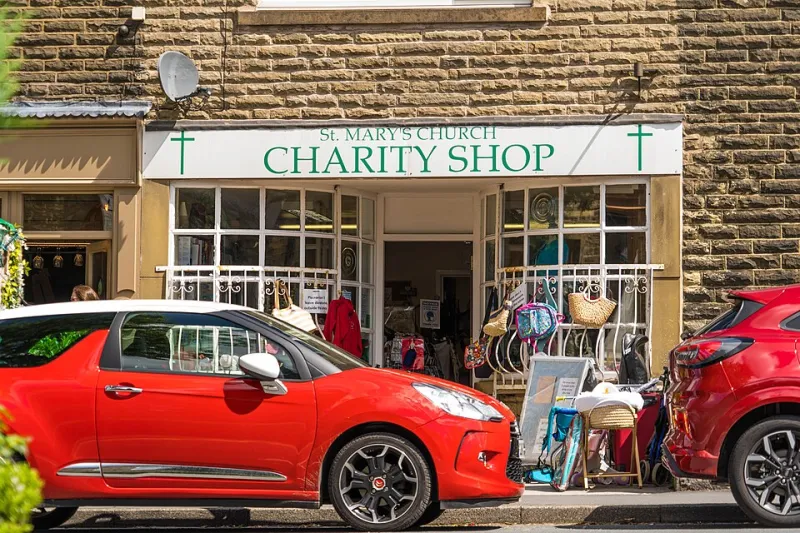
Photo: Claireneon, CC BY-SA 4.0, via Wikimedia Commons
There is a particular smell to a charity-shop back room: dust, old cardboard and faint furniture polish. Somewhere in the corner is a box of trading cards that nobody has sorted since 2004. You pay £5, take it home, and spend an hour finding out whether it is treasure or recycling. It is not efficient. That is the point.
Online breaks are fine in their place. Singles are fine too. But the modern card hobby has become very good at selling us the feeling of the chase while removing most of the actual chasing. The charity-shop rummage puts the chase back where it belongs: in your hands, in a slightly damp church hall, with a cup of tea and no countdown timer.
The online lottery has its place, but it is not the chase
A break is a lottery ticket with production values. You pay for a slot, watch someone else open packs on a livestream, and hope your name comes up when the good card appears. It can be fun. It can also be an expensive way to watch other people open cardboard. The odds do not change because there is a camera and a chat room. Singles are the sensible option if you know exactly what you want, but clicking buy and waiting for the postie is not the same as hunting.
The charity-shop and car-boot circuit is the opposite. The odds are low, the cost is low, and the story is almost always better. You might find nothing. You might find a £2 holo that pays for the afternoon. You might find a box of football stickers, a battered binder of Magic commons, or a sports-card album with one page that makes the whole trip worthwhile. The uncertainty is the entertainment, not an add-on.
What actually turns up in British charity shops
Not usually sealed booster boxes. Anyone who tells you otherwise is either lucky, mistaken or selling something. What you do find is the messy stuff: half-finished albums, tins with a mix of sets, loose cards in elastic bands, football stickers, Magic commons, Yu-Gi-Oh! cast-offs and the occasional sports card that has been in a drawer since the 1990s. Hospice shops and local charity shops are often better than the big-name stores because the stock is more random. House clearances and church-hall table sales are where the real cardboard archaeology happens.
Car-boot sales are the other great British institution. Get there early enough to see the good boxes but not so early that you are standing in a field in the dark. Church-hall clear-outs, village fetes and parish newsletter sales are gentler. You will often find a table of £1 bundles, a tombola and someone who knows exactly where the cards came from because their grandson left them in the loft.
How to spot the good stuff without buying the junk
Look for the binder, not the loose pile. A dirty binder with a few old holos is usually more interesting than a neat stack of modern bulk. Check the back before the front. Whitening, creases, water damage and sun fade tell you more about condition than a shiny front. Know your sets well enough to spot an older reverse holo, a trainer gallery card or a sports insert that has been priced as a nothing card.
Bulk is bulk. If you are buying a thousand-card box for £10, ask yourself why you want it. If the answer is that you enjoy sorting, fine. If the answer is that you think there must be a gem in there, be honest about the odds. Watch for fakes, especially on popular Pokémon cards, and do not pay vintage prices for modern reprints. Ask about the box behind the counter. Charity shops often keep cards out of the way because they do not know what to do with them.
A £5 rule helps. Take a fiver, spend a fiver, and treat anything you find as a bonus. It keeps the afternoon fun and stops a rummage turning into a speculative shopping spree.
The etiquette bit
Volunteers are not card dealers. They are giving up their Saturday to sell you a jigsaw and a Danielle Steel paperback. Do not haggle in a charity shop. Do not open sealed packets and leave them open. Do not make a mess on the table and walk away. Ask before you dig through a box that is behind the counter. Buy something small even if you find nothing. At car-boot sales, ask politely, accept no for an answer, and do not crowd someone who is already looking.
The same goes for church-hall clear-outs. If there is a queue, join it. If there is a price list, read it. If someone is holding a box, wait. The hobby has enough sharp elbows online. The offline version should be better than that.
The car-boot and church-hall circuit
In 2026, the online market is picked over fast. The good stuff is photographed, listed and sold before most of us have had breakfast. The church hall still has a paper table and a raffle. Local Facebook groups, parish newsletters and shop windows are still the best listings for the scruffy stuff. Take cash, a sturdy bag and a water bottle. Wear shoes you do not mind getting muddy. If you are going to a car boot, take a friend and agree a budget before you get there.
The pleasure is not just the find. It is the walk, the chat, the terrible tea and the moment when you realise the box you nearly left behind has a page of cards you actually want. A break gives you a hit or nothing. A charity-shop afternoon gives you a story either way.
Why it beats the online lottery
The £5 punt is a bounded risk. You are not chasing a return on investment. You are buying an afternoon of possibility. That is a different kind of thrill from watching a breaker open a case on a screen. It is slower, cheaper and more social. It also keeps money in local shops and halls rather than in a livestream overlay.
None of this is an argument against buying singles. If you want a specific card, buy the card. But if you want the chase, the chase is still out there in the scruffy boxes. It just does not have a countdown timer, a chat room or a postage fee. Take a fiver, take a free afternoon, and see what British cardboard has been hiding.